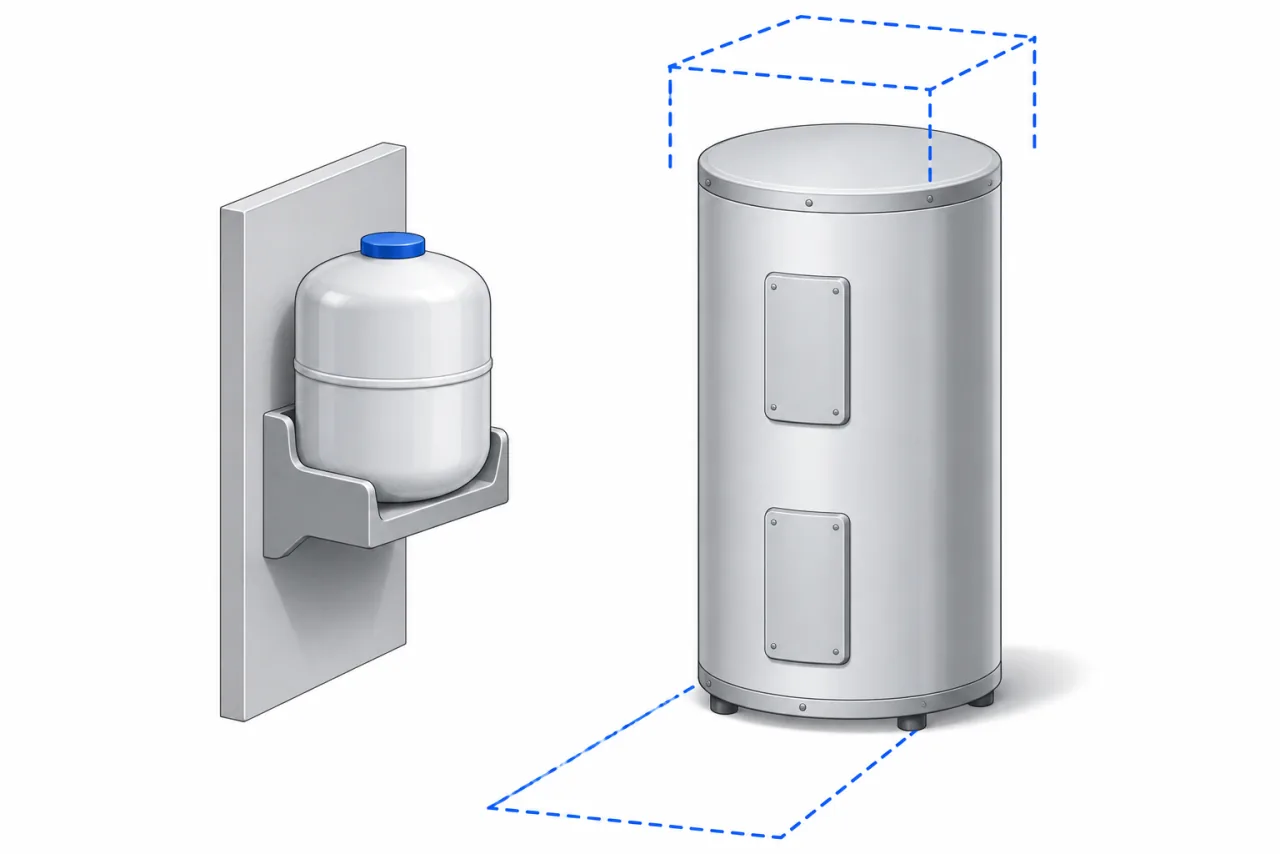
Three separate checks before mounting
Water-only load · calculated example
Add the actual documented empty vessel weight. These volumes are examples, not model specifications or support ratings.
- 01Location
The connection must remain on the heater side of the verified one-way boundary.
- 02Support
Use the tank’s actual full-load weight and the approved support arrangement.
- 03Service access
Keep the model’s relief, anode and other service access available.
Location is a circuit question
Amtrol’s FAQ (opens source in a new tab) places its expansion tank at the water heater’s cold inlet and, when a backflow or check valve is present, after that device. MC10007 page 3 (opens source in a new tab) also explains why water held in a tank connected on the hot outlet can cool between uses and affect delivery. This is a manufacturer-specific location reference, not a complete piping plan.
Use the boundary record to keep the branch and isolated heater circuit together. Do not connect an expansion vessel to the relief opening or obstruct the discharge path. Shutoff arrangements, fittings and permitted details must come from the applicable manual and qualified installation design.
Support the actual full load
Empty shipping weight is not worst-case supported weight. For a simple water-filled load estimate, add 8.33 lb for each US gallon of water to the documented empty vessel weight. This uses the same approximate water density as the energy model. The volume and empty weight must be actual model specifications, not a rounded catalog nickname.
| Illustrative recorded item | Calculation | Scope |
|---|---|---|
| 2.0 US gal water volume | Water alone ≈ 16.66 lb | Add the actual documented shell weight. |
| 4.5 US gal water volume | Water alone ≈ 37.49 lb | This is not the complete vessel load. |
| Example only: 2.0 US gal and an assumed 5 lb empty shell | 16.66 + 5 ≈ 21.7 lb | 5 lb is an assumption, not a product specification or bracket rating. |
Amtrol permits supported alternative orientations (opens source in a new tab) under the model instructions. This does not mean any strap, wall anchor or pipe can carry the load. Wall structure, support hardware, vibration and orientation must be assessed for the actual installation. The page makes no generic bracket or fastener recommendation.
Keep a service-access envelope
- Relief device
Preserve the manufacturer’s access and unobstructed discharge arrangement.
- Anode or service component
Identify whether the particular heater has the component in that location. Obtain its access/removal requirement from the model manual; there is no universal rod length here.
- Heat-pump filter or duct
For a heat-pump model, check the actual air-path and service requirements. A drawing for a conventional tank does not establish those clearances.
- Existing equipment
Do not let a new branch make a shutoff, electrical cover or required service path inaccessible. Have the proposed layout checked against the manual.
A better installation question
Ask the installer to identify the manual revision, connection location, full-load assumption, approved support arrangement and service envelope on the same proposed layout. This is more useful than asking only whether a tank “can be horizontal.” Use the document guide to distinguish general support guidance from actual model instructions.
Sources and limits
Reviewed 2026-11-15. The linked method and your model manual take precedence over an explanatory example.
- Amtrol MC10007 · sizing and placement (opens source in a new tab)
03/19. Pages 2–3: 40°F-base factors, DPF, pre-charge example and placement. Manufacturer-specific guidance; local and model requirements still apply.
- Amtrol · plumbing and hot-water support (opens source in a new tab)
Live FAQ. Pre-charge matching, cold-inlet location and supported orientation. Use the installation manual for the actual model.
- U.S. DOE · residential water heater guidance (opens source in a new tab)
Guidance updated May 2024. Heat-pump modes use the compressor and resistance elements differently. Supports excluding a single fixed resistance model from heat-pump recovery predictions.