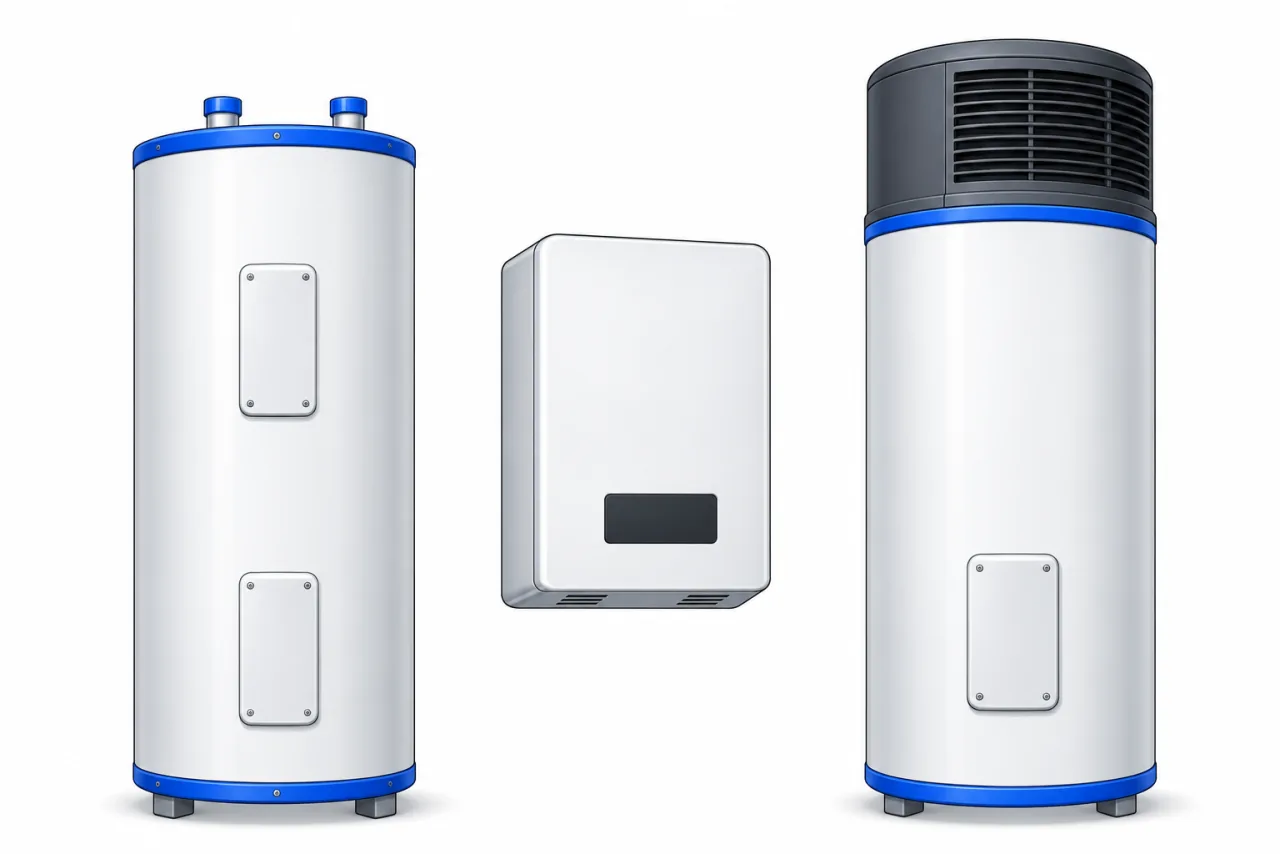
Identify what is actually being heated
Record the stored volume and the isolated system boundary.
Find the unit’s return-loop diagram, internal checks and any buffer volume.
Storage volume still matters for expansion; recovery additionally depends on operating mode.
The heated volume must come from the actual arrangement
A storage-heater worksheet starts with a recorded stored-water volume and a verified isolated circuit. A tankless arrangement may include an exchanger, return pipework, internal or external check devices, a pump and sometimes a buffer. The product name alone cannot establish the heated trapped volume or the required expansion provision. Do not borrow a storage-tank answer without checking the actual unit’s drawing and method.
A return loop adds questions, not a universal vessel size
- Locate the model-specific diagram
Which return arrangement is described by the manufacturer, and does the installed system match it?
- Identify the one-way devices
Which checks or backflow arrangements isolate which parts of the heated circuit? Internal components may not be visible externally.
- Identify stored or trapped water
Does the documented method count an internal buffer or the return loop, and under which temperature conditions?
- Find the actual expansion instruction
If the manual specifies an expansion arrangement or vessel, retain its conditions and model scope. This site does not generalize a “2-gallon” requirement.
The document guide can help organize the record. This site has not independently verified every tankless model or recirculation configuration. If the relevant unit manual is missing, the correct output is a question for the manufacturer or installer, not an invented volume.
Storage expansion and heat-pump recovery are separate tasks
A heat-pump storage heater still contains stored water, so the recorded volume and isolated pressure boundary remain relevant to expansion review. Recovery, however, can depend on compressor, resistance elements and mode controls. DOE’s residential guidance (opens source in a new tab) distinguishes efficiency, hybrid and higher-demand operation. A single fixed resistance input should not be used to forecast every operating mode.
A change from 50 to 66 US gal increases the illustrative 40→140°F expanded volume from 0.75 to 0.99 US gal. That does not prove an existing expansion tank must be replaced: the previous tank’s actual acceptance, pressure conditions and available margin still need to be checked. Increased demand and insufficient capacity are different statements.
Take a scope record to the right source
Keep the heater and any buffer models, the recirculation mode, the drawing revision, the recorded water volume, pressure boundary and unresolved questions together. For a verified storage circuit within the worksheet assumptions, use the expansion record. For heat-pump recovery, use the model’s mode-specific performance rather than our gas/resistance cold-start worksheet.
Sources and limits
Reviewed 2026-11-15. The linked method and your model manual take precedence over an explanatory example.
- Amtrol MC10007 · sizing and placement (opens source in a new tab)
03/19. Pages 2–3: 40°F-base factors, DPF, pre-charge example and placement. Manufacturer-specific guidance; local and model requirements still apply.
- Amtrol · plumbing and hot-water support (opens source in a new tab)
Live FAQ. Pre-charge matching, cold-inlet location and supported orientation. Use the installation manual for the actual model.
- U.S. DOE · residential water heater guidance (opens source in a new tab)
Guidance updated May 2024. Heat-pump modes use the compressor and resistance elements differently. Supports excluding a single fixed resistance model from heat-pump recovery predictions.