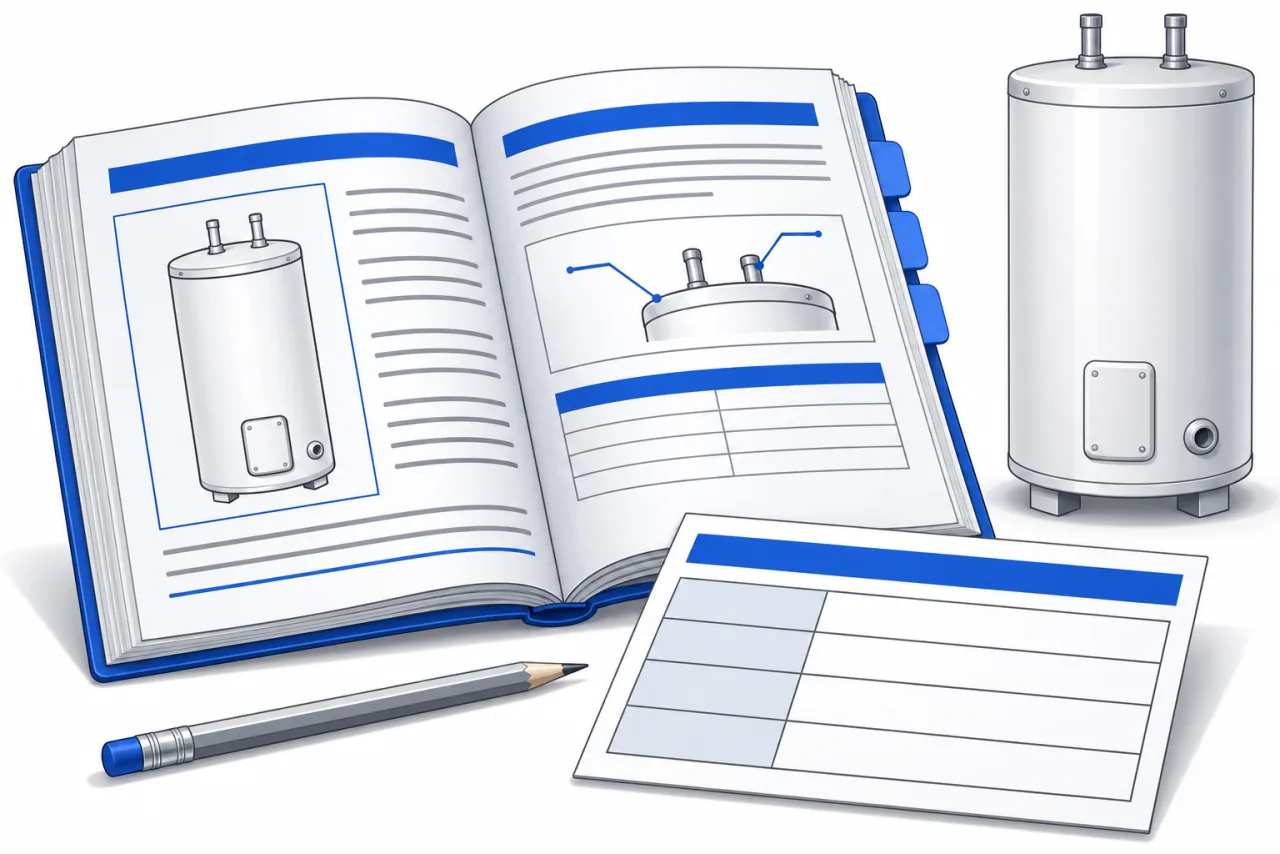
Amtrol MC10007 · sizing and placement (opens source in a new tab)
Pages 2–3: 40°F-base factors, DPF, pre-charge example and placement. Manufacturer-specific guidance; local and model requirements still apply.
03/19 · primary reference · reviewed 2026-11-15
Amtrol · plumbing and hot-water support (opens source in a new tab)
Pre-charge matching, cold-inlet location and supported orientation. Use the installation manual for the actual model.
Live FAQ · primary reference · reviewed 2026-11-15
Watts · potable expansion sizing conditions · source record
Distinct initial/final pressure and temperature conditions. Its 85%-of-relief ceiling and 90°F starting-water note must not be silently mixed with another method.
Live tool instructions · primary reference · reviewed 2026-11-15
Direct access was restricted during our check. This is a record of the official page’s conditions, not a working copy of the calculator. The original source address is retained below; use the available manufacturer documents for a checkable comparison.
Official source address: https://www.watts.com/resources/planning/etp
A.O. Smith University · expansion calculator (opens source in a new tab)
Separate supply pressure, pre-charge, relief rating and temperatures; separate acceptance and total-volume outputs. Interface read; no independent certification of its algorithm.
Live tool · primary reference · reviewed 2026-11-15
Watts LFRC105 · bypass and high pressure (opens source in a new tab)
Page 1: this regulator’s bypass behavior and possible high-pressure causes. Not a rule for every PRV.
IS-LFRC105 1633 (2016) · primary reference · reviewed 2026-11-15
A.O. Smith · relief-valve Bulletin 52 (opens source in a new tab)
Temperature/pressure relief roles and rating limits. An observation form cannot establish a specific fault.
Bulletin 52; publication date not stated · primary reference · reviewed 2026-11-15
A.O. Smith · what UEF measures (opens source in a new tab)
UEF is a standardized usage-based efficiency rating; it is not a direct heat-to-water efficiency input for this cold-start equation.
Live explainer · primary reference · reviewed 2026-11-15
U.S. DOE · residential water heater guidance (opens source in a new tab)
Heat-pump modes use the compressor and resistance elements differently. Supports excluding a single fixed resistance model from heat-pump recovery predictions.
Guidance updated May 2024 · primary reference · reviewed 2026-11-15
10 CFR 430 · Appendix E, first-hour rating (opens source in a new tab)
FHR begins with a fully heated non-flow-activated heater. This reference establishes the distinction, not current legal compliance or a certified rating for any product.
2025 published edition, Appendix E §1.5 · primary reference · reviewed 2026-11-15
No matching reference. Try a broader topic, or obtain the manual for your exact model.
Three methods, different conditions
| Primary path | What to retain | Why outputs may differ |
|---|---|---|
| Amtrol MC10007 page 2 | 40°F-base factor, static pressure, allowable maximum, matching pre-charge and required expanded-water/total volumes. | Different initial temperatures or maximum pressures change the arithmetic. |
| Watts ETP | Its starting-water instruction, initial and final pressures, pre-charge and margin below relief rating. | A field called final pressure is not interchangeable with a relief rating. |
| A.O. Smith University | Capacity, supply, pre-charge, relief rating, start/end temperatures and both output volumes. | An acceptance output is not the same quantity as minimum total tank size. |
A practical comparison sequence
- Match the task
Potable storage expansion, a hydronic circuit and a tankless recirculation question may require different documents.
- Match the input definitions
Retain units, start temperature, where pressure is measured and whether the value is static, design or relief.
- Keep separate outputs
Compare expanded-water acceptance to acceptance, and total tank volume to total volume. Do not compare unrelated fields because both say gallons.
- Record a genuine difference
If definitions or conditions do not match, state the difference before judging a calculator. An inaccessible old URL does not prove a manufacturer has no suitable tool.
Find the model instructions as well as a general tool
A calculator and general FAQ can explain a method. They do not establish permitted orientation, support, temperature or acceptance for an unnamed tank. Use the manufacturer, complete model identifier and relevant manual revision already available on the equipment record. If that manual cannot be found or matched, retain the item as missing and ask the manufacturer or installer. This directory does not claim complete brand or model coverage.
Copy the questions, not an unsupported recommendation
Ask which starting-water temperature and design ceiling apply, whether pre-charge was established in the required condition, and which model satisfies both volume requirements at those pressures. Include any regulator/bypass and recirculation uncertainties. The expansion worksheet’s summary retains entered conditions and sources for that conversation; it does not select a SKU.
Three different pressure fields
Illustrative values, not measurements of a home.
- Static supply
- The recorded baseline at the stated location and condition.
- Design ceiling
- A design condition taken from the applicable method or installer.
- Relief rating
- The safety valve’s rating; not a routine operating target.
External references open in a new tab; the Watts ETP entry links to its clearly labeled source record above. Availability can change and an automated-access restriction is not evidence that a public tool is broken. Source retrieval is separate from validating a manufacturer’s internal algorithm.