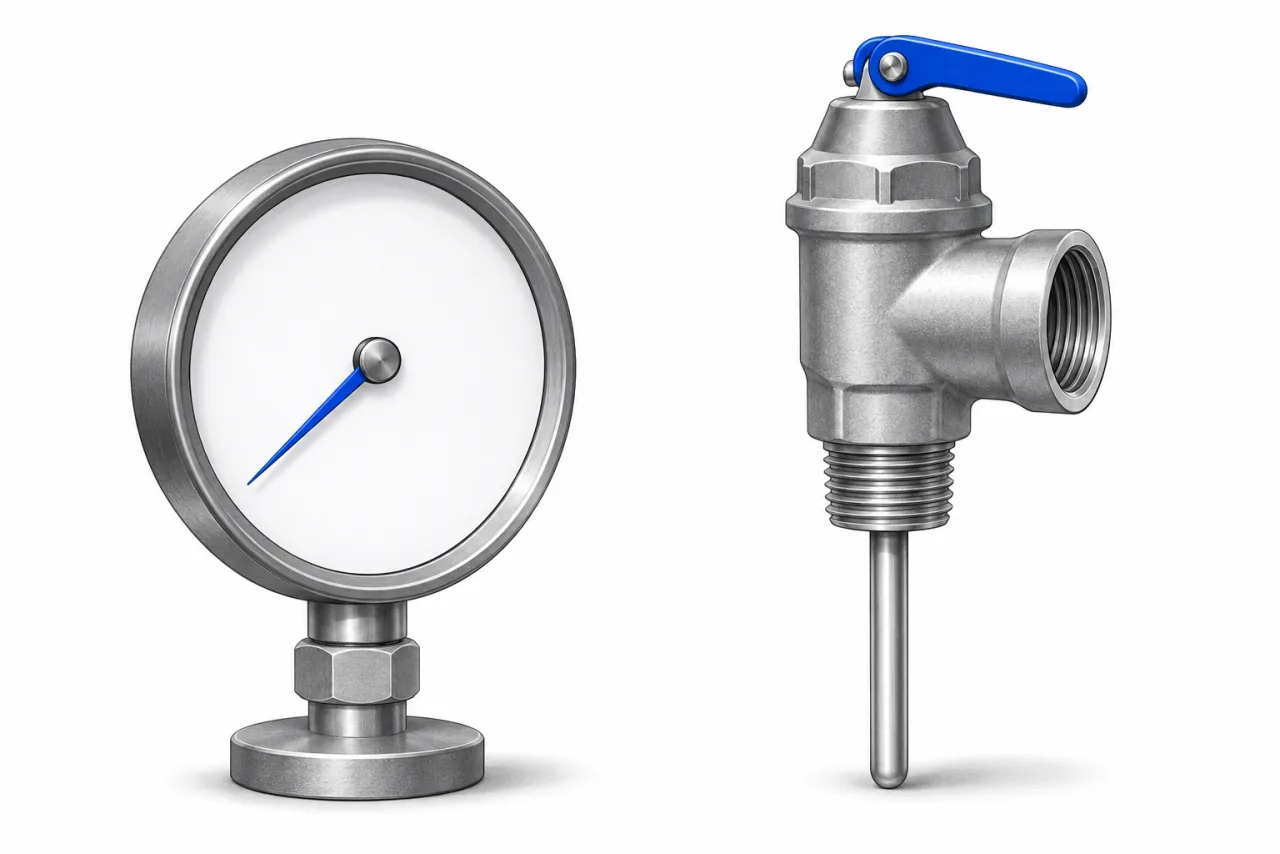
Two devices with different jobs
An expansion tank cushions a change in water volume within its design conditions. A temperature-and-pressure relief valve is a safety device with its own ratings. A.O. Smith Bulletin 52 (opens source in a new tab) explains those distinct pressure and temperature functions and the need to respect the heater and component ratings. A relief rating is not the desired routine operating pressure, and a relief pipe must not become a connection point for an expansion tank.
What timing can and cannot tell you
| Observation | A useful question | Conclusion to avoid |
|---|---|---|
| Drip during or after recovery | Could heating-related pressure change be involved? What readings and circuit changes are documented? | The expansion tank has definitely failed. |
| Drip while apparently idle | What is the supply record, and has pressure, valve condition or heating been checked? | The PRV must be leaking because it is nighttime. |
| Hot, forceful or steam discharge | How can qualified help be obtained safely under the manufacturer guidance? | A new expansion tank will fix the event. |
These rows are questions, not probabilities. A video, clock time or pressure band does not rule out other conditions. The Watts LFRC105 troubleshooting section (opens source in a new tab) names thermal expansion, pressure creep and material on a valve seat as possible high-pressure causes for that product. It does not let a short observation form choose among them.
Prepare a useful record
- Identify the outlet
Describe where water appears without touching hot components or dismantling equipment. A threaded-connection leak is a different observation from discharge through the relief pipe.
- Keep the timing
Record whether heating or a hot-water draw was observed, rather than assuming the heater was off because no one was using a tap.
- Describe pressure evidence
State whether an existing value was static, flowing or a retained peak, where and when it was taken, and which instrument or installer record supplied it.
- List changes
Include a recent meter, regulator, treatment device or heater replacement. A change is context, not proof of causation.
What the form intentionally withholds
It does not assign a failed component, estimate safety from a drip rate, approve further operation or recommend replacement parts. An “unknown” pressure record remains unknown. If the pressure record is above the worksheet scope, the next step is professional review of the conditions, not manipulating an input until a sizing result appears.
Use the copy or print summary for observations already available. Further inspection must follow the exact heater manual and qualified service judgment. The source guide helps separate a general bulletin from instructions for the installed model.
Sources and limits
Reviewed 2026-11-15. The linked method and your model manual take precedence over an explanatory example.
- A.O. Smith · relief-valve Bulletin 52 (opens source in a new tab)
Bulletin 52; publication date not stated. Temperature/pressure relief roles and rating limits. An observation form cannot establish a specific fault.
- Watts LFRC105 · bypass and high pressure (opens source in a new tab)
IS-LFRC105 1633 (2016). Page 1: this regulator’s bypass behavior and possible high-pressure causes. Not a rule for every PRV.
- Amtrol MC10007 · sizing and placement (opens source in a new tab)
03/19. Pages 2–3: 40°F-base factors, DPF, pre-charge example and placement. Manufacturer-specific guidance; local and model requirements still apply.