What the comparison means
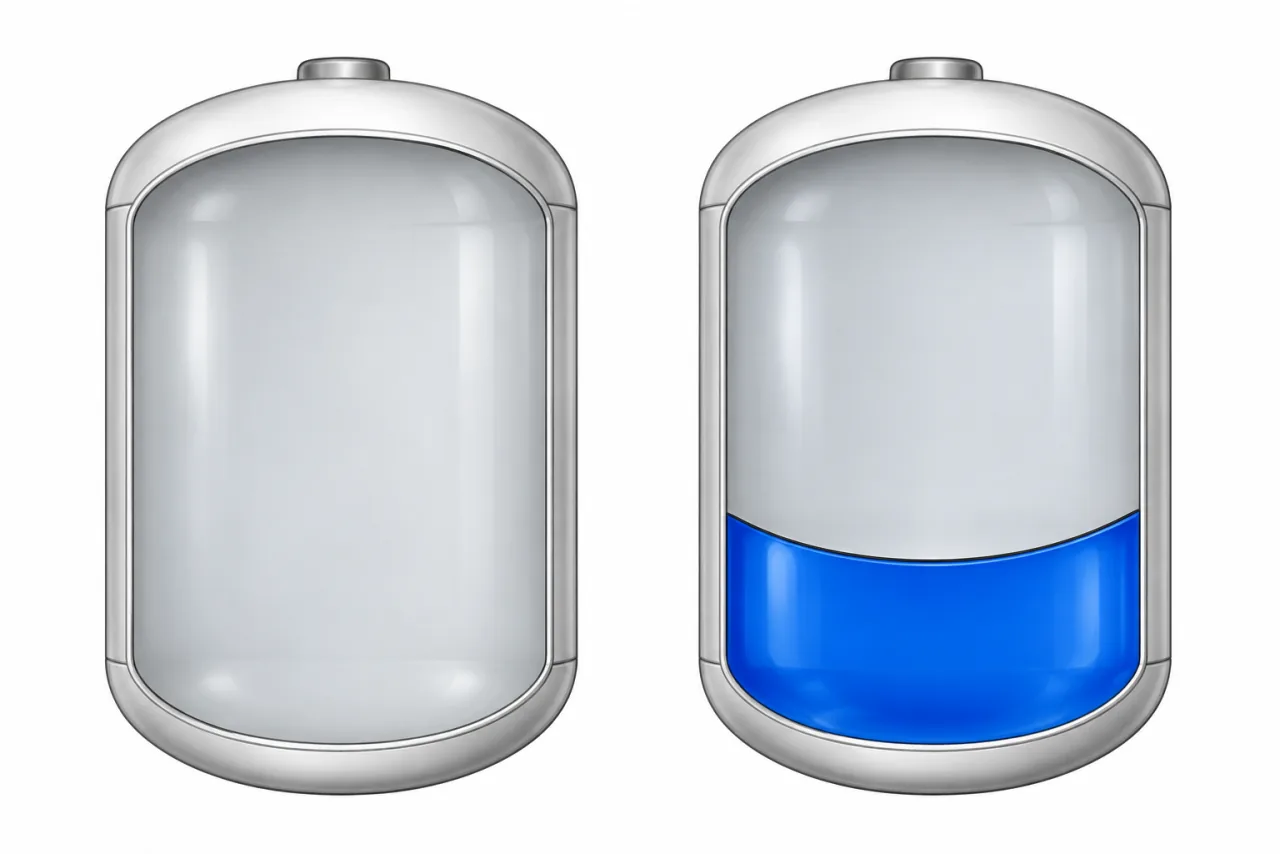
The air cushion compresses when water pressure exceeds the initial air pressure. Amtrol’s published 40/70 psig example (opens source in a new tab) explains why leaving its tank at a 40 psig factory charge on a 70 psig supply admits water before heating starts. Using absolute pressures, the remaining ideal air-volume fraction is (40 + 14.7) / (70 + 14.7) = 64.6%; the cold water occupies about 35.4% of the initial volume.
The percentage describes ideal cold pre-compression. It is not the tank’s usable hot-water acceptance, diaphragm stroke rating or remaining service life. Matching pressures removes that particular cold-volume loss in the ideal model; it does not make all tank volume available during operation. The final pressure and manufacturer acceptance limits still matter.
Which pressure record do you have?
| Record | What it establishes | What it does not establish |
|---|---|---|
| Factory label | The stated shipping condition for that model. | Current unpressurized air charge after installation or service. |
| Air reading on an active water system | A reading affected by the current water-side pressure. | An independent pre-charge measurement. |
| Unpressurized pre-charge record | The recorded air condition with water-side pressure removed, if the documented procedure was valid. | A diagnosis of diaphragm condition or suitability of the model. |
The Amtrol FAQ (opens source in a new tab) calls for pre-charge matching before installation. This page does not provide draining or air-adjustment instructions. If the measurement condition is not documented, retain it as unknown and ask qualified service to establish it under the actual manual.
Three useful comparisons
- 40 psig pre-charge / 70 psig static
Approximately 35.4% cold-volume occupation in the model. This explains pre-compression, not a replacement recommendation.
- 60 psig pre-charge / 60 psig static
No modeled cold-volume occupation from a pressure mismatch. Rated acceptance remains a separate condition.
- 75 psig pre-charge / 55 psig static
An ideal threshold difference of 20 psi exists before water can enter. It does not predict an actual peak pressure or prove what happens every heating cycle.
Keep the context for service
Save the model and manual revision, whether the value is a label or a measurement, the water-side condition at measurement, location and date, and the associated static supply record. Our form accepts a limited pressure range and withholds comparisons above it. That restriction is deliberately narrower than a universal product catalog; Watts ETP’s pre-charge ceiling · source record is a condition of that method, not permission to adjust another product.
Sources and limits
Reviewed 2026-11-15. The linked method and your model manual take precedence over an explanatory example.
- Amtrol MC10007 · sizing and placement (opens source in a new tab)
03/19. Pages 2–3: 40°F-base factors, DPF, pre-charge example and placement. Manufacturer-specific guidance; local and model requirements still apply.
- Amtrol · plumbing and hot-water support (opens source in a new tab)
Live FAQ. Pre-charge matching, cold-inlet location and supported orientation. Use the installation manual for the actual model.
- Watts · potable expansion sizing conditions · source record
Live tool instructions. Distinct initial/final pressure and temperature conditions. Its 85%-of-relief ceiling and 90°F starting-water note must not be silently mixed with another method.