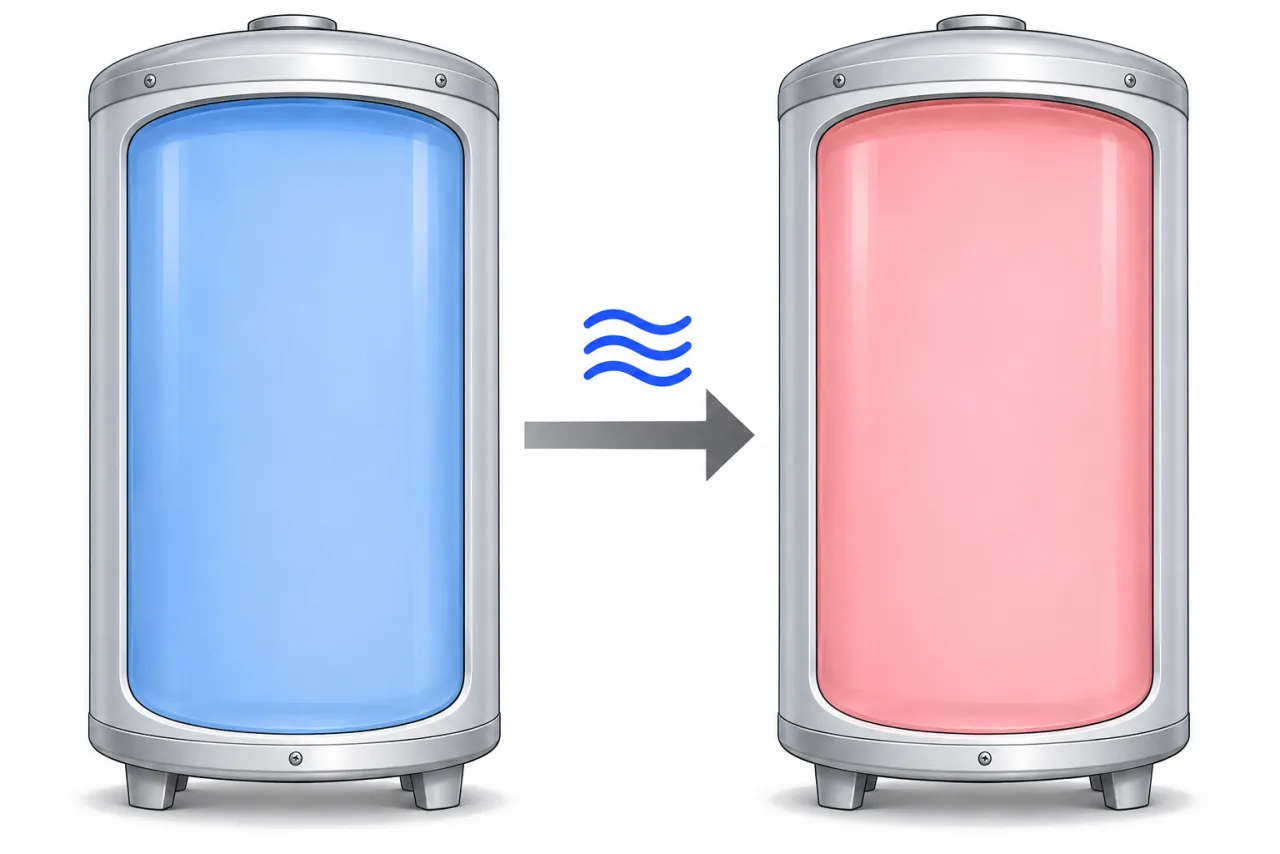
What the calculation represents
The model starts with the entire recorded storage volume at the incoming-water temperature. It assumes a constant useful heating rate, no water draw during heat-up and an efficiency input that represents heat delivered to the water. With density approximated as 8.33 lb per US gal and specific heat as 1 BTU/(lb·°F), the energy balance gives:
GPH = useful BTU/h ÷ (8.33 × ΔT)
Minutes = 60 × US gallons ÷ GPH
For electric resistance input, this worksheet uses 1 kW ≈ 3,412 BTU/h. Those constants and the uniform-water simplification are engineering approximations, not instrument readings. Actual cycling, standby loss, mixing and stratification can change the time. The output is an explanation of the stated assumptions, not a service-time promise.
Choose the right power and efficiency
Use the input active in the stated recovery condition. Adding the ratings of two elements that do not run together would overstate the useful heating rate. For gas, burner input and useful heat-to-water output are not interchangeable. The form requires an input and its source; it does not silently assume that a manufacturer’s headline efficiency is suitable.
A.O. Smith’s UEF explanation (opens source in a new tab) describes a standardized usage-based rating. Do not paste UEF into this equation as thermal efficiency. The example uses η = 0.98 for electric resistance and is explicitly an assumed scenario, not a measured property of your heater. If the appropriate efficiency is unknown, keep the result on hold.
Check the worked result
For 50 US gal, 4.5 kW resistance input, assumed η = 0.98, and 45→120°F: useful input is about 15,047 BTU/h, the calculated rate is 24.08 GPH and whole-tank cold heat-up is about 124.6 minutes. Increasing only the rise from 60°F to 80°F increases this model’s time by one-third. That is a conditional ratio, not a claim about every winter or location.
Why this is not first-hour rating
Appendix E’s first-hour definition (opens source in a new tab) starts with a fully heated heater and concerns hot-water delivery during an hour. A cold-start estimate begins with stored water cold. The two initial states differ, so multiplying our GPH by an hour or adding nominal tank capacity cannot produce a certified FHR. Use the model’s published rating for an actual capacity comparison.
Systems outside this model
Heat-pump storage heaters can operate with different combinations of compressor and resistance heat. DOE’s mode guidance (opens source in a new tab) explains why a fixed resistance input is not a substitute for mode-specific performance. Tankless delivery, active draws, recirculation losses and changing staged output are also outside this worksheet. Keep the selected mode and input source with any professional comparison.
Sources and limits
Reviewed 2026-11-15. The linked method and your model manual take precedence over an explanatory example.
- A.O. Smith · what UEF measures (opens source in a new tab)
Live explainer. UEF is a standardized usage-based efficiency rating; it is not a direct heat-to-water efficiency input for this cold-start equation.
- U.S. DOE · residential water heater guidance (opens source in a new tab)
Guidance updated May 2024. Heat-pump modes use the compressor and resistance elements differently. Supports excluding a single fixed resistance model from heat-pump recovery predictions.
- 10 CFR 430 · Appendix E, first-hour rating (opens source in a new tab)
2025 published edition, Appendix E §1.5. FHR begins with a fully heated non-flow-activated heater. This reference establishes the distinction, not current legal compliance or a certified rating for any product.